
ScholarSpring
File the FAFSA, claim the Pell, add state grants, then stack scholarships. ScholarSpring hands a student the aid ladder in that order, matched from 1,689 awards down to their own county.
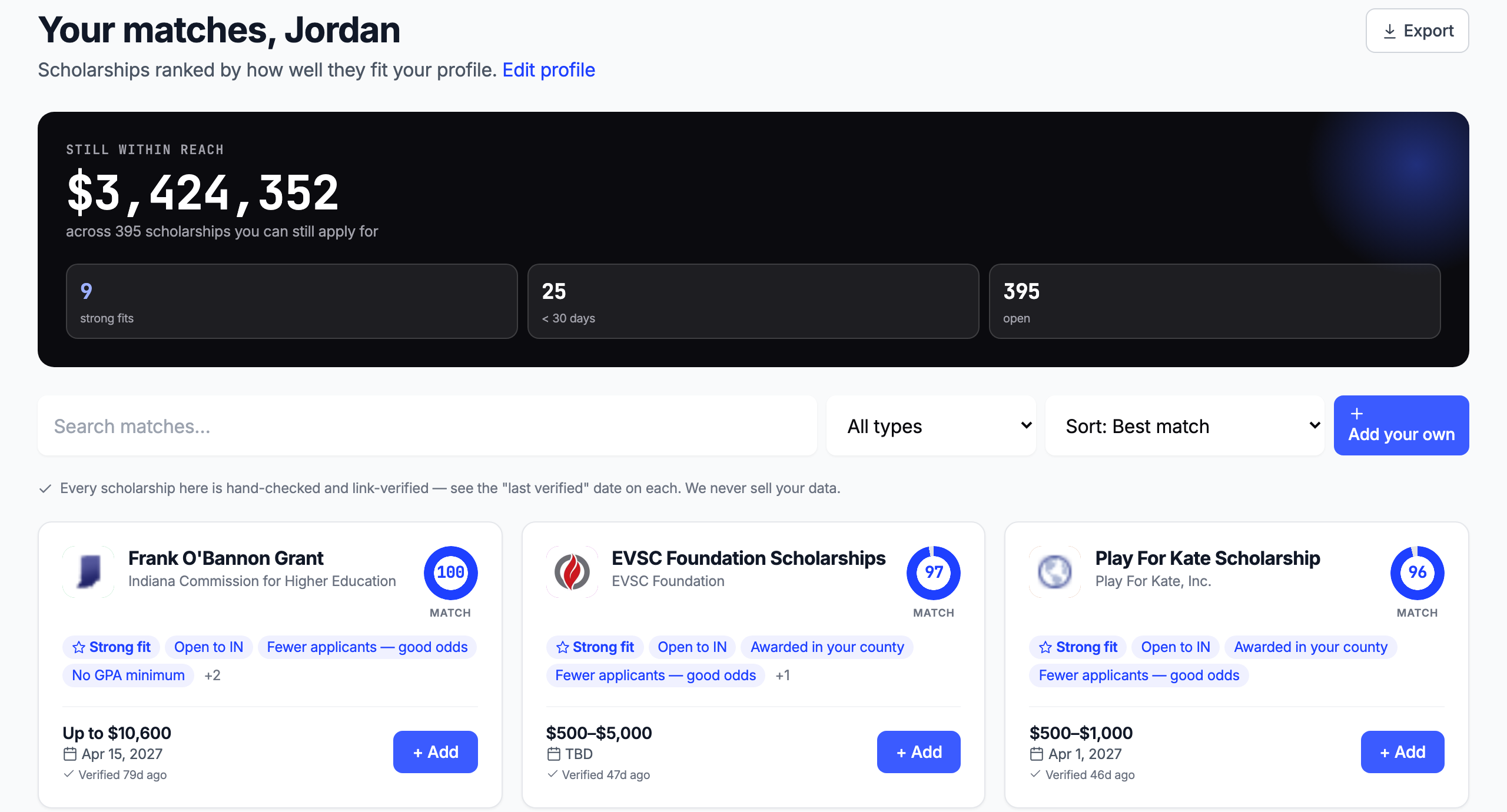
A student opens ScholarSpring, answers a few short screens about grade, state and ZIP, and gets a ranked list of the money they can still apply for. Tell it you are an Indiana senior in Evansville with a 3.4 and it finds 395 open awards worth $3.4 million. First is the Frank O'Bannon Grant, Indiana's need-based state grant, which asks for nothing but a FAFSA filed by April 15. The next three are paid out only in that student's own county.
The FAFSA comes before any scholarship
Forty percent of families use no scholarship money at all, and 70% of those never apply. The most common reason they give, at 34%, is that they didn't know what they qualified for (Sallie Mae, How America Pays for College 2025). The larger pile is federal and needs no essay.
The class of 2024 left $4.4 billion in Pell unclaimed
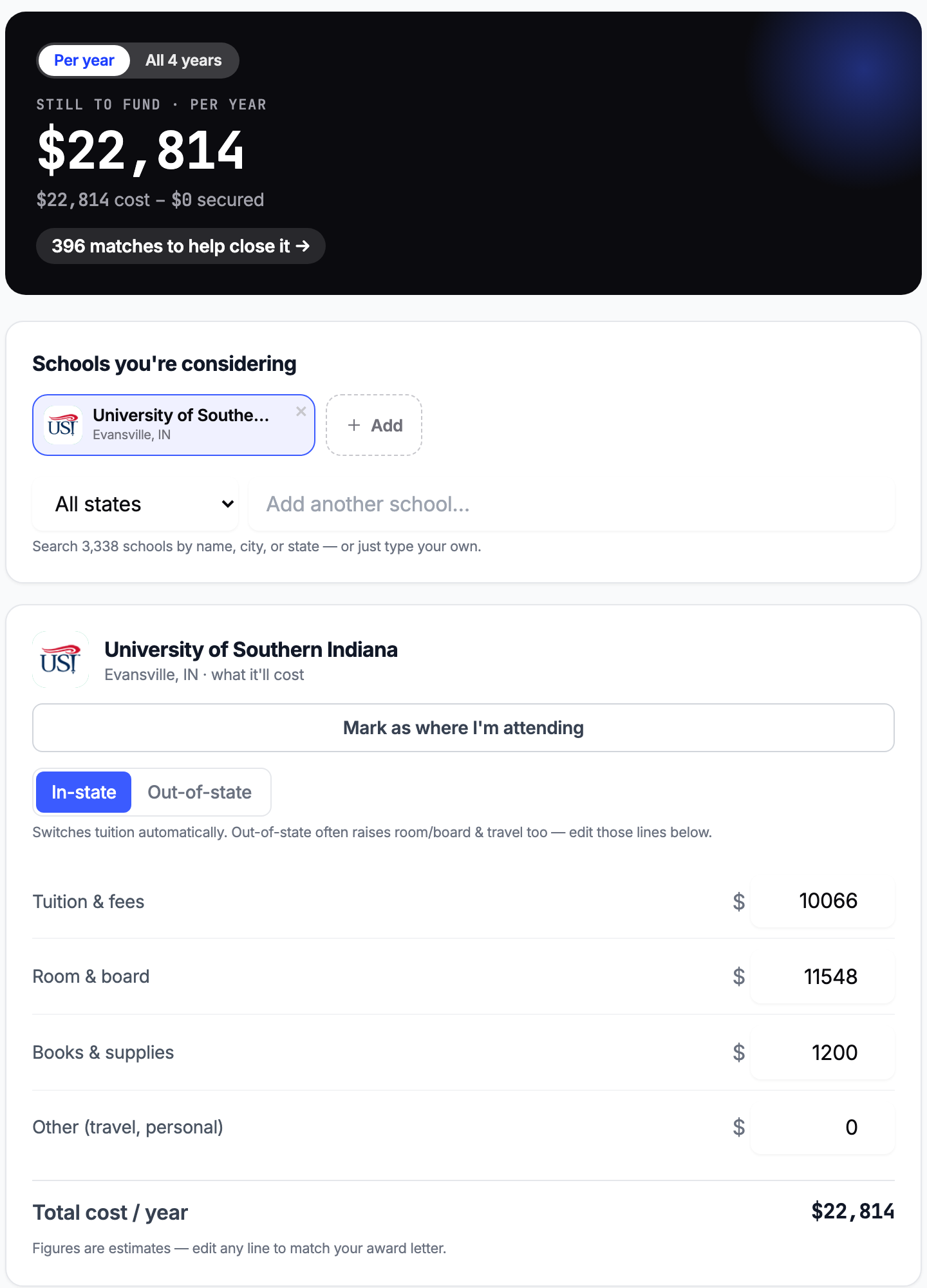
That money went unclaimed through incomplete FAFSAs (NCAN). So the funding plan opens on the FAFSA, links to the free tools at studentaid.gov, and says plainly that ScholarSpring files nothing and collects no financial information. Then it prices a school. Pick one of 3,338 colleges from the federal College Scorecard list and it fills in tuition, room and board and books, subtracts whatever the student has already secured, and shows the gap. For the University of Southern Indiana that gap starts at $22,814 a year, with 396 matches lined up against it.
A county foundation gets no search traffic, so the catalog starts from the IRS
Search ranks by traffic, and a county community foundation has none, so a catalog built from search finds the same national awards everyone else lists. ScholarSpring's starts from the IRS Business Master File, the federal registry of nonprofits, and researches sponsors one at a time. In Kentucky and Indiana that meant 359 organizations, 141 of which run an award a student can apply for. Colleges come from the same College Scorecard list the plan uses, starting with schools in Kentucky, Indiana, Ohio and Tennessee, each read for the aid it publishes.
- Awards in the app
- 1,689
- Colleges in the plan
- 3,338
- Nonprofits researched, KY and IN
- 359
- Colleges researched, KY, IN, OH, TN
- 326
- Catalog refresh
- Monthly
The border states are there on purpose. Schools across the river spend money to recruit, and some pay non-residents more than residents. Xavier pays any Ohio, Kentucky or Indiana graduate at least $31,000 a year automatically at a 3.5 weighted GPA. Shawnee State gives free tuition to students from three Kentucky counties.
Each award reaches only the students who can win it
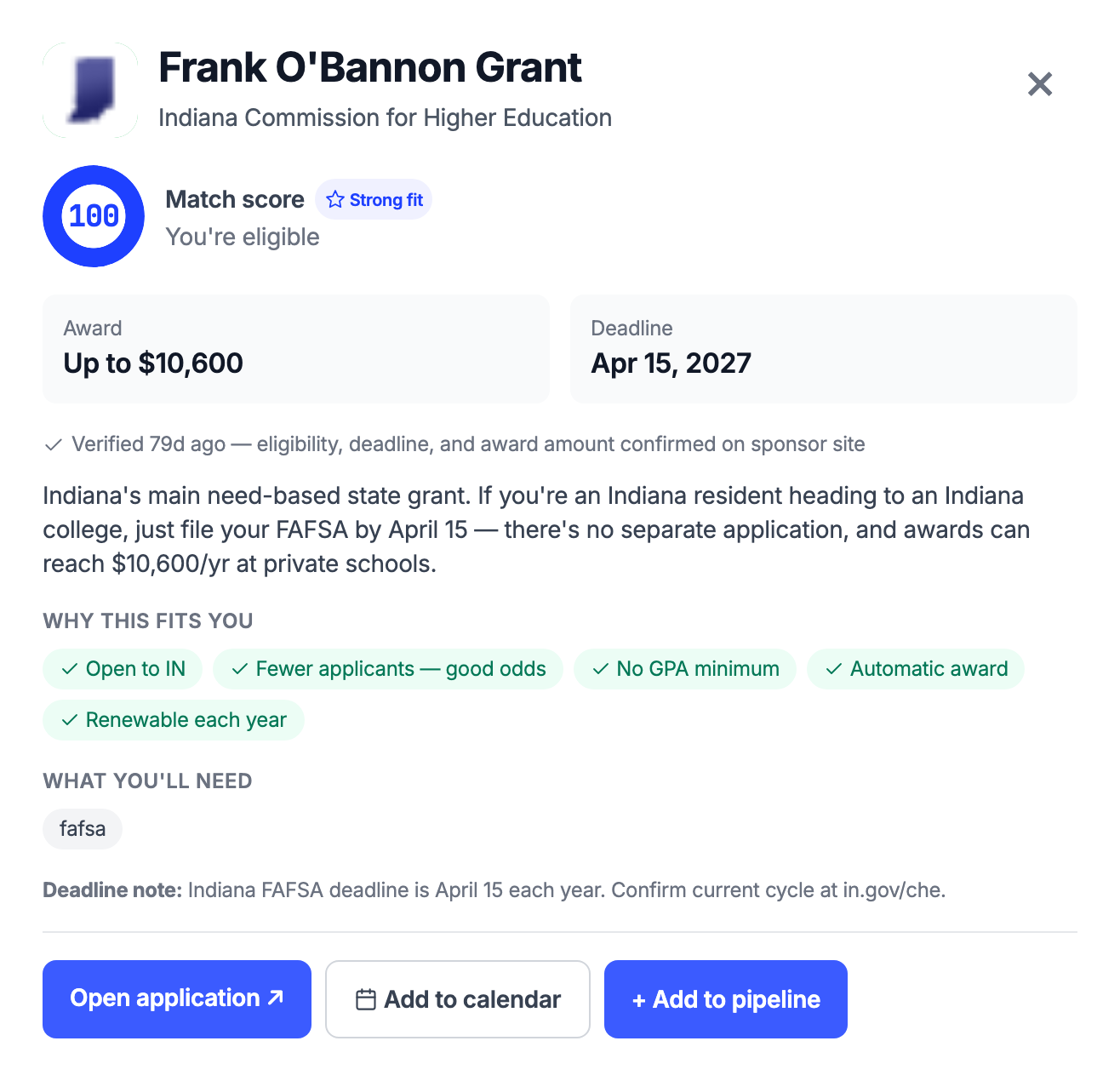
Matching runs on hard eligibility rules first, like state, class year and level. A ZIP becomes a county through the Census crosswalk, and an award written for one county ranks first for the students who live there instead of crowding the top of everyone else's list. An award from one college shows only to a student who named that college. Every card says why it fits, in plain tags like "No GPA minimum" and "Automatic award."
Deadlines carry the same weight. College merit money closes in the fall, mostly on November 1 and December 1, while most other aid closes in spring. A senior who starts looking in March has already missed Purdue's Trustees Scholarship, Notre Dame's merit awards and WKU's Cherry Presidential, so the app sorts and badges by days left.
An award gets into the catalog only if its link reaches the sponsor's own instructions for applying. A donation page or a bare homepage does not count. The validator rejects donate links, and every new or changed link is fetched again before the monthly refresh ships.
The profile lives on the phone
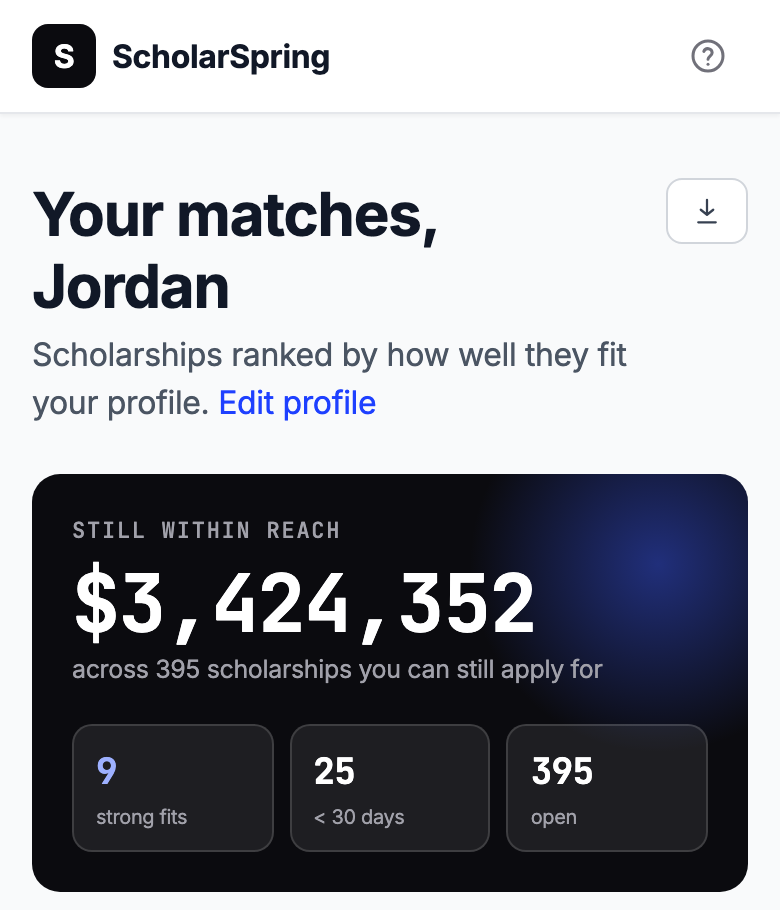
There is no account. The profile, the saved list and the funding plan stay in the browser on the student's device, and the student can export them as a PDF or CSV or back them up to a file. The app counts anonymous events, like a profile created or a scholarship saved, and nothing about who did it. Free scholarship sites have usually paid for themselves with student data: in April 2026 Scholly's founder sued Sallie Mae, which bought Scholly, alleging it sold student data, minors' included.
Counselors are the next audience. The design on the table gives them opt-in counts computed on each student's phone, "34 of your 210 seniors filed the FAFSA," and never one student's record. That part is not built yet.
Students never pay
The plan is to fund it the way banks have long funded free financial-education tools in schools: a regional bank or foundation as the named sponsor, and per-cohort licenses for college-access programs like GEAR UP and AVID. No lenders, no colleges paying per student, no ads aimed at student data. The web app is live and works on any phone with no install. The iOS app is in TestFlight.
Want to talk about ScholarSpring?
Get in touch →coachhouse.so/scholar-spring