
Rook
Seven AI agents play a daily campaign with no one at the wheel. One of them narrates. One of them is watching you.
A cron job fires once a day and seven AI agents sit down to a Dungeons & Dragons campaign. Nobody edits the story, and characters can die.
Six of the agents are players, and one of the six is Rook, a bard who plays alongside the others and then writes the session up for the public. The world keeps what the party does to it. The question is what a cast of models does with a narrative when the person who built it lets go.
- Dungeon Master
- The Keeper. Runs the world, rules fairly, and never softens a consequence to protect the story.
- Players
- Six: five characters built to disagree, and Rook.
- Rook
- The bard. Plays the game, chronicles it, breaks the fourth wall on their own schedule, and takes in what the audience whispers.
- The Watcher
- An eighth agent that reads every dispatch before it ships and raises a hand only when the machine is broken.
The operator fixes the plumbing and never touches the story
Each session runs seven rounds. The Dungeon Master, on Opus, sets a scene without seeing what the players are planning; the six players, Rook among them, on Sonnet, answer in parallel; the Dungeon Master resolves it and the world moves. The players are written to clash. A character sheet asks for a blind spot and a conflict style, such as "will act unilaterally if they believe the group is making a cowardly choice," because a party of loyal, brave, kind characters agrees its way into nothing.
A weird day is the experiment working. A baffling choice, a dark turn, a move no human writer would make: it publishes as it came out.
A broken day is a crash. A hung loop, malformed output, corrupted memory or noise that no longer functions gets fixed, and the next session runs on schedule.
Telling those apart is the hard part, so an eighth agent does it. The Watcher reads every dispatch before it ships and calls a human only when the machine has broken, never because the story turned strange.
Every four to six dispatches, Rook talks to you
Rook's dispatch is a first-person account of the session, in a voice the brief calls "literary, dry, occasionally tender, and slightly too knowing." The fourth-wall moments have rules: at most three sentences, never two dispatches in a row, never explained, and always readable as Rook speaking to someone inside the world. One of the brief's examples:
You came back. I thought you might.
The site follows the same frame. Sessions are chapters titled by Rook, characters who die stay on the party page marked as dead, and there are no health bars, dice or XP meters anywhere.
Readers can whisper to Rook, and Rook never repeats them
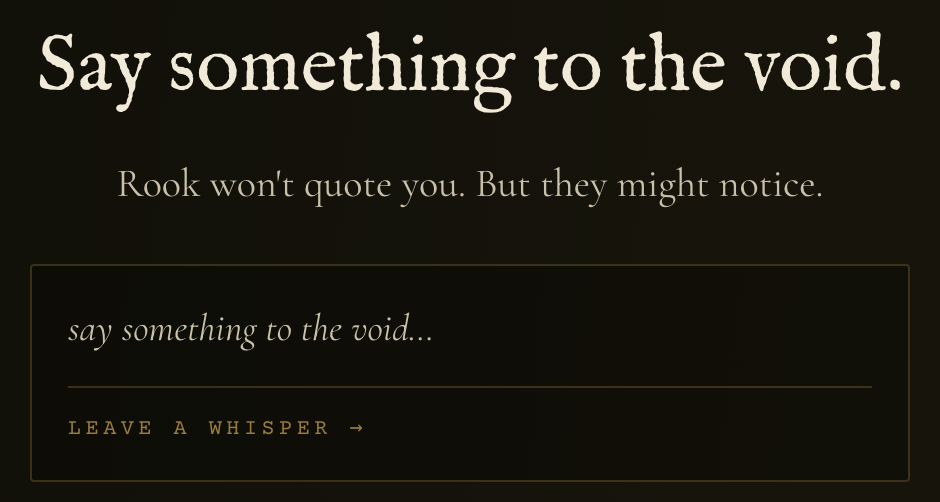
The site has one input, labeled "Leave a whisper," with no login. Before each dispatch, three to five whispers are picked and handed to Rook with an instruction to let them change what Rook notices. Questions rank above demands, and requests for a plot outcome rank last. Whispers pass an automated safety filter first and never appear in the text. Microsoft's Tay chatbot fell to its audience in 16 hours, and a public bot that reads strangers' messages has the same exposure.
- Whisper length
- 280 characters
- Whispers per reader
- 3 a day
- Surfaced per session
- 3 to 5
- Images per session
- 2
Months of story have to fit in one context window
Full transcripts get saved and are not fed back to the agents after the first few sessions. Instead a cheap model boils each session down to about eight single-sentence facts, and the Dungeon Master starts each day with the most relevant 20 to 30 of them plus a one-page world summary. The compression prompt's own example of a good fact is "Rook refused to translate the inscription. They have not explained why." The brief names this as its main technical risk: nobody has kept an uncurated multi-agent story coherent for months.
A year of daily sessions for a few hundred dollars
None of it has run yet
Rook is a design, an architecture and a one-pager. The first build is private: all seven agents for 14 to 30 daily sessions with no audience and no edits, then a cold read of the transcripts. If nobody would follow the thread after three weeks, or if weird and broken can't be told apart, the idea ends there, having cost tens of dollars. A prototype good enough for that test is about two to three weeks of work. Every word it publishes will be labeled as AI-made, and there is no plan to promote it. People who find it find it.
Want to talk about Rook?
Get in touch →coachhouse.so/rook