
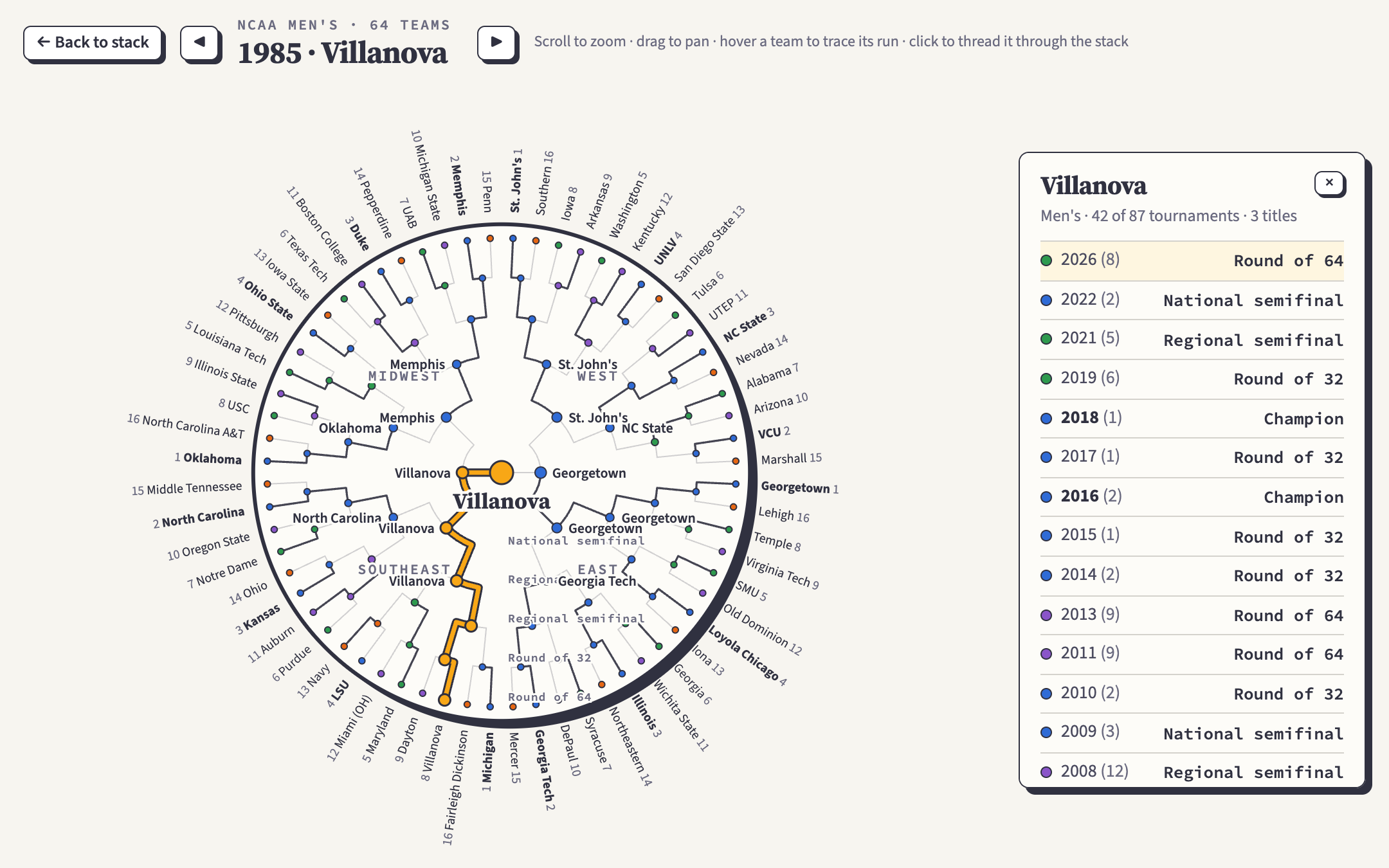
A bracket is a sheet you fill out once a year and throw away. Dance Card draws every NCAA tournament as a circle instead: the whole field on the rim, a ring in for each round won, the champion alone in the middle. Then it stacks them by year, 87 men's tournaments since 1939 and 44 women's since 1982. It is the college basketball twin of Open Drawer, which does the same for tennis.
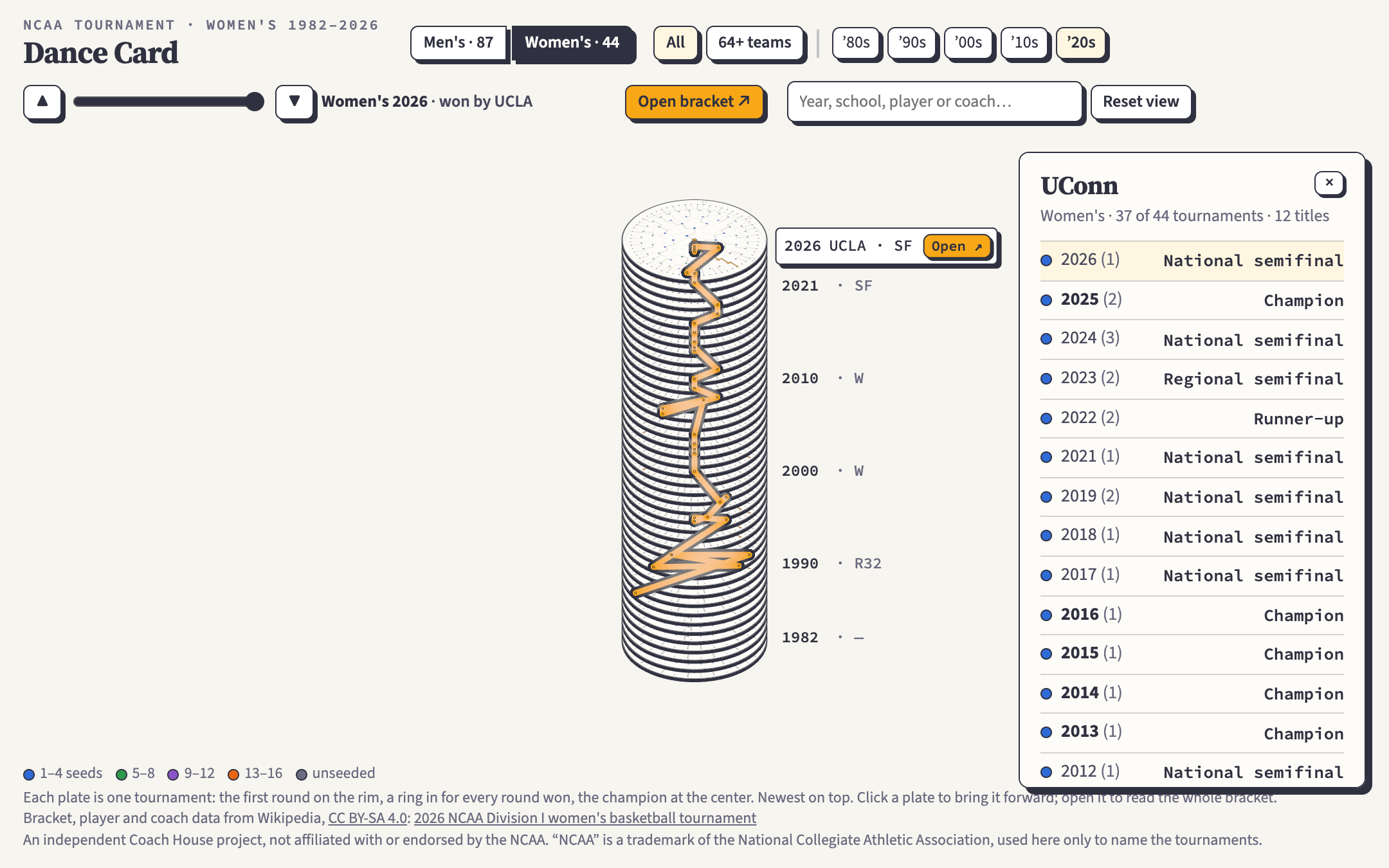
Pick a program and its whole tournament history becomes one line
Click UConn in the women's stack and a thread drops through 37 of the 44 tournaments, staying near the center of the plates because it went deep almost every year. The panel keeps score: 12 titles. Search takes a year, a school, a player or a coach, and a coach's thread follows them from school to school: Rick Pitino's runs from Providence to Kentucky to Louisville. Dots are colored by seed, so a double-digit seed on a run shows up as a warm dot deep inside its plate. Click any plate to pull it forward, then open it to read the whole bracket with every team around the rim.
The field grew from 8 teams to 68, so every bracket is rebuilt from its games
Wikipedia keeps each tournament's bracket as templates, and the templates change with the field: one 8-team bracket in 1939, uneven regionals of 22 to 25 teams with byes through 1974, and play-in games at the rim today. Dance Card reads the games instead of the layout, finds the one team that never lost, and walks back from the title game. Each program keeps one identity through renames, so Oklahoma A&M's thread carries on as Oklahoma State and Texas Western's as UTEP.
All 131 title games match a second source
Want to talk about Dance Card?
Get in touch →coachhouse.so/dance-card